Cantilever Rack for Long Stock
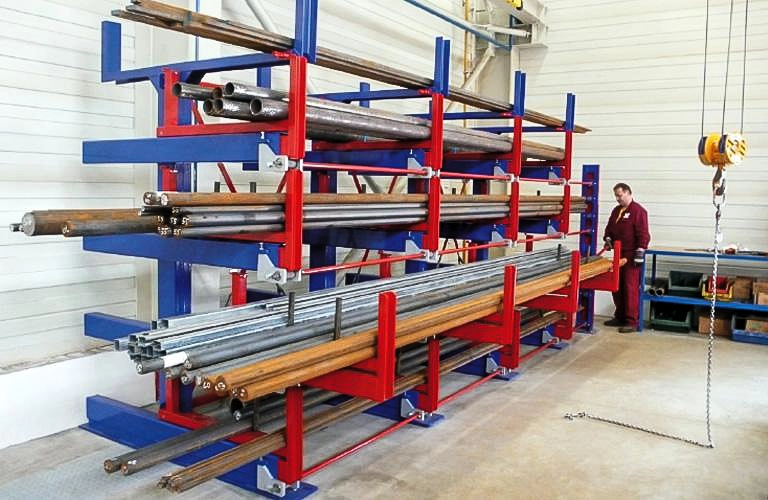
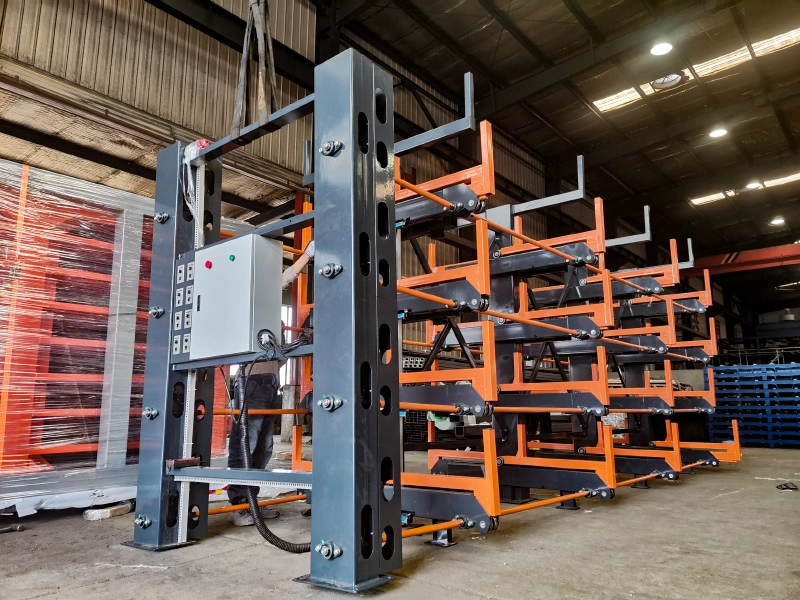
A telescopic cantilever system for storing long stock — tubes, sectional bar and structural shapes, aluminium profiles 6–12 m long — purpose-built for elevator manufacturers. It keeps elevator guides, long cabin-frame sections and door-frame sections sorted by section and length, always at hand at the machining and assembly stations. A rack-and-pinion drive lets one operator manually extend the arm to 100% with a single handle movement, opening direct vertical access by overhead crane to any tier. No forklift or wide aisles are needed.
Request a QuoteKey Advantages
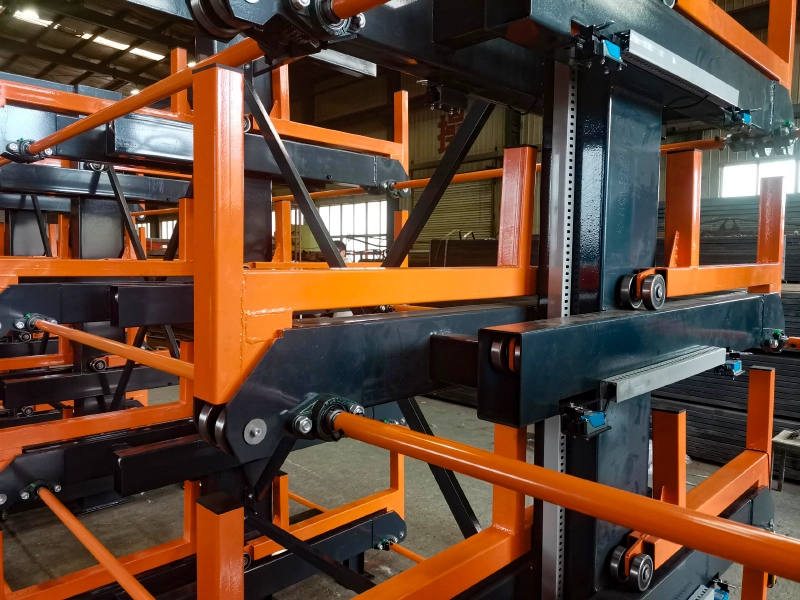
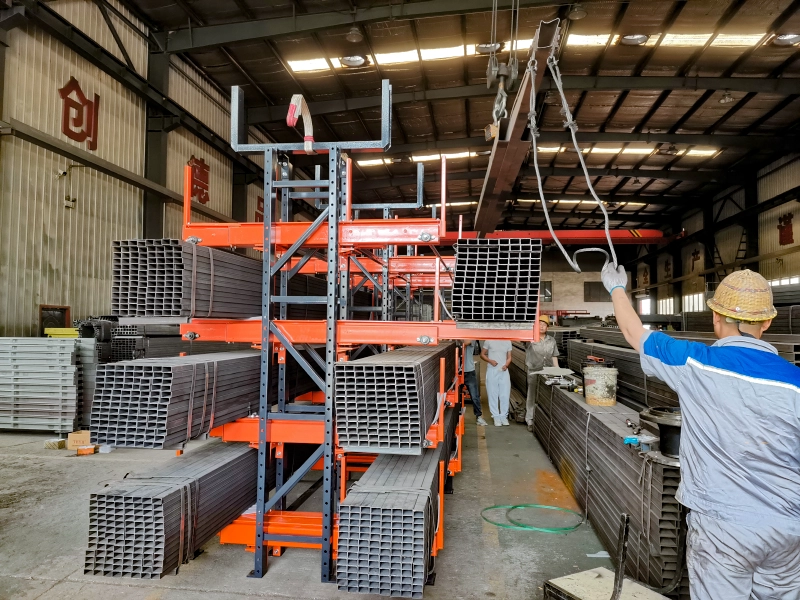
Every arm extends to full reach, fully opening top access to the material. An overhead crane with a vacuum gripper or nylon sling picks the needed position strictly vertically — without side dragging and surface scratches.
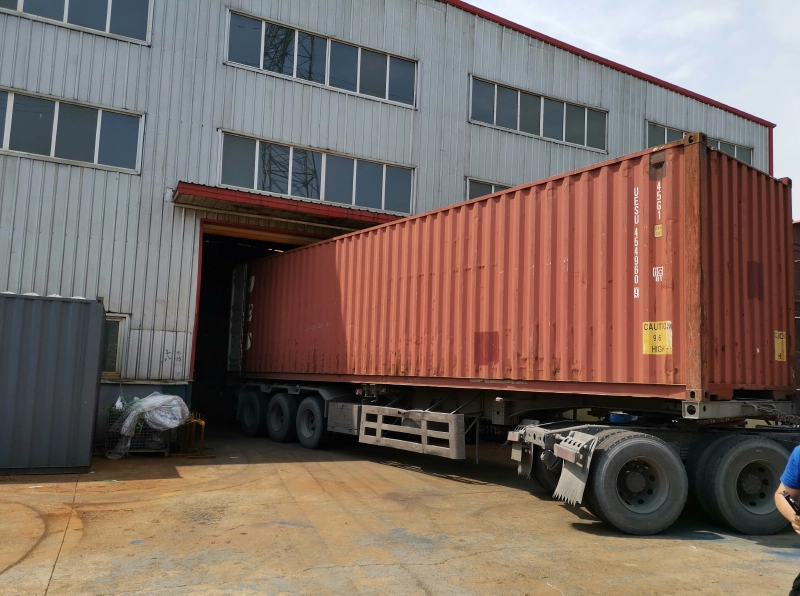
A composite post and bolted Knock-down joints let you break the system into a flat pack for a standard 40-foot container (door opening 2.34 m). 40% more units per container versus fully welded analogues — real savings on sea freight.
Dropping the forklift shrinks the working aisle from 4–6 m to 1–1.5 m — storage density doubles. Selecting any tier by hand in 2 minutes instead of 15–20 minutes “picking through” the top layers in floor storage.
Product Photo Gallery
Technical Specifications
| Parameter | Value |
|---|---|
| Category | Racks |
| Structure type | Telescopic cantilever rack for long stock (rack-and-pinion drive) |
| Stored material length | 6–12 m (tubes, sectional bar, structural shapes, aluminium profile) |
| Load per arm | up to 3000 kg (strength margin 1.25× of rated) |
| Starting torque (manual control) | 15–25 N·m — one-hand control by a single operator |
| Arm reach | 100% — full extension for vertical overhead-crane access |
| Post cross-section | 250×150×4 mm, rectangular tube (Q235B) |
| Main material | Structural steel Q235B |
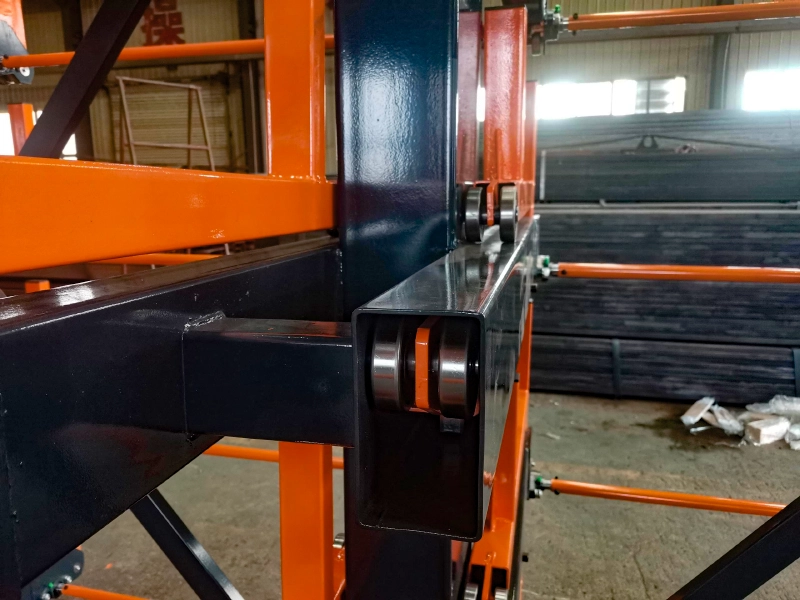
| Drive type | Rack-and-pinion with bevel gear and synchronizing shaft |
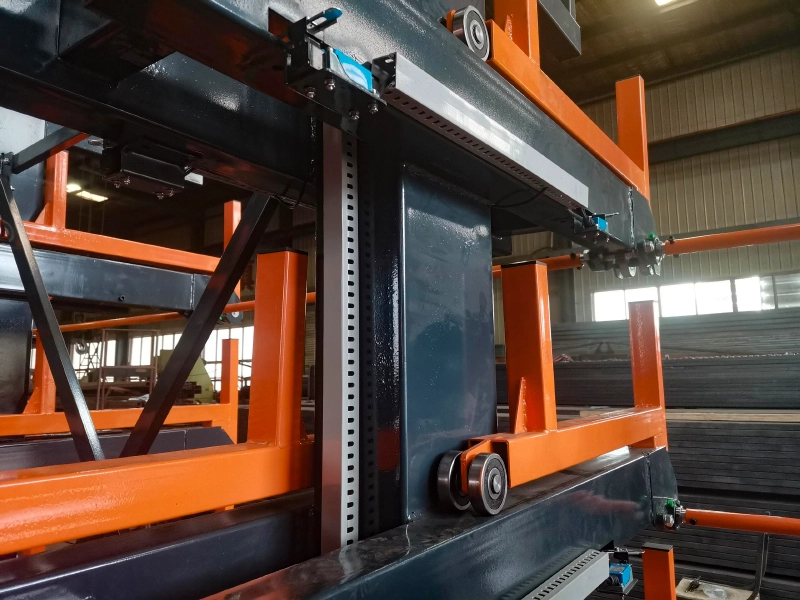
| Colour scheme | RAL 7016 (anthracite — posts) / RAL 2008 (orange — arms) |
| Safety | Limit rollers, safety pins, derailment protection, OSHA 1910.176(b) |
| Additional surface protection | UHMW polyethylene inserts in the arm (option) — zero contact with material |
| Compatible lifting equipment | Overhead crane / bridge crane + vacuum gripper or nylon sling (must be above the rack) |
| Floor requirements | Level concrete or epoxy floor with capacity for the full load |
| Production lead time | 6–8 weeks |
| Packaging and assembly | Fully knock-down for sea container; on-site assembly by 3 people in 1 day, no welding |
Frequently Asked Questions
How is a telescopic arm better than a fixed one?
A fixed arm needs a forklift with side access — a 4–6 m working aisle. A telescopic arm fully extends into the aisle, after which the overhead crane picks the material vertically. The aisle shrinks to 1–1.5 m, storage density doubles, and the risk of forklift-tine scratches disappears completely.
Is it hard to manually pull out a 3-tonne arm?
No. The rack-and-pinion with gearbox keeps the starting torque in the 15–25 N·m range — comparable to opening a heavy industrial door. The operator smoothly pulls the loaded arm to full reach with one hand, without hydraulics or electric drive.
Is it suitable for stainless tubes without scratches?
Yes. The material surface never contacts forklift tines — only vertical lifting by nylon sling or vacuum gripper. Optional UHMW polyethylene inserts in the arm prevent scratches even on mirror stainless and anodised aluminium profile. The solution meets zero-contact requirements for aerospace and pharma materials.
How does overseas sea shipping work?
The knock-down structure packs into a flat pack for a standard 40-foot container (door opening 2.34 m). Compared with fully welded cantilever racks of the same capacity, 40% more units fit in one container — a substantial saving on sea freight for transoceanic deliveries. On-site assembly — 3 people in 1 day, no welding, using bolted joints and the manual.