
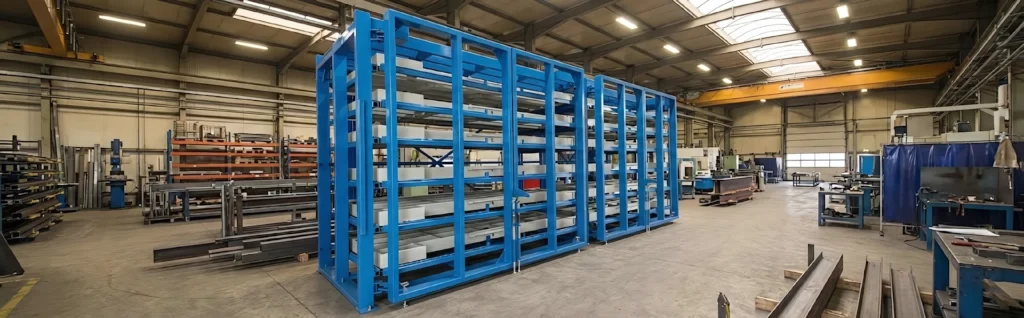
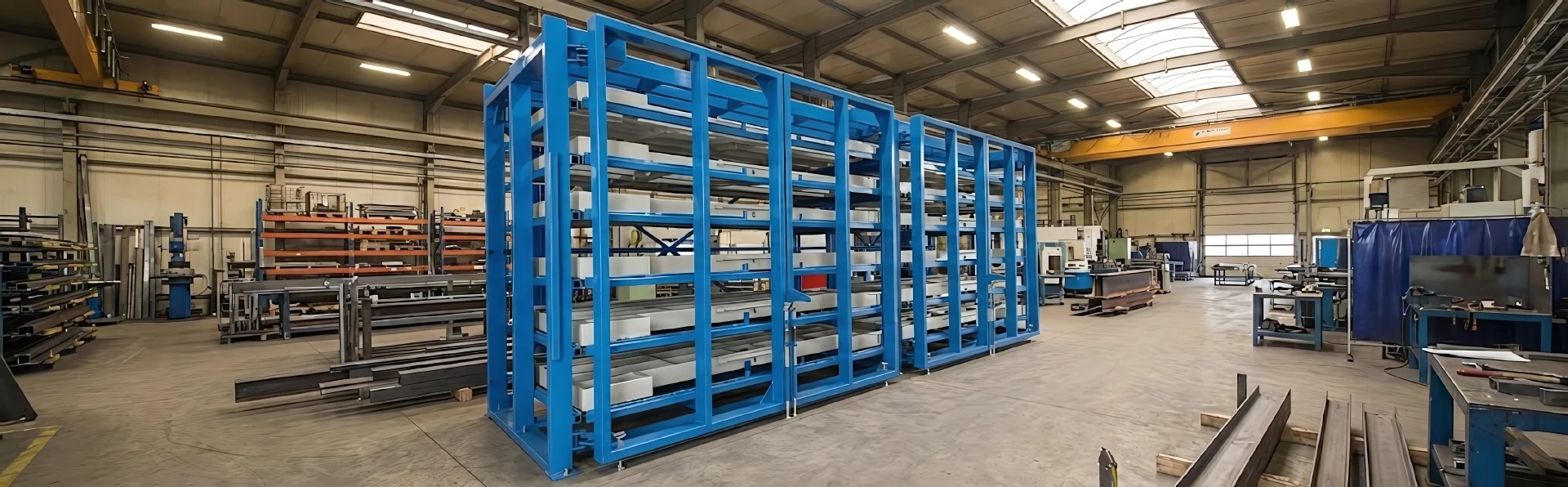
At most enterprises, sheet metal is stored in floor stacks or on universal racks. It seems cheap and simple — but hidden costs accumulate every day. Let us look at the real problems of stacked storage and how the modular Bplarack system solves them.
Problem 1: Sheet surface damage
When sheets lie on top of each other, the upper sheet scratches the lower one with every move. For thin sheet (1–3 mm) this means loss of blank quality even before laser cutting. For stainless steel and aluminium — visible surface defects that cannot be removed.
In the Bplarack system every sheet is placed in a separate pull-out drawer. Sheets do not contact each other — the surface stays undamaged from intake to machine feeding.
Problem 2: Long search for the right blank
In a stack of 20 sheets the needed one is usually at the bottom. To get it out you must remove and shift 19 upper sheets. That takes 15–30 minutes and needs two workers. With high item variety (40+ types) search time eats up to 20% of the shop's working time.
Bplarack solves the task differently: every drawer extends independently. Access to any item takes 10 seconds. One operator, without helpers.
Problem 3: Low storage density
A 1-metre-high stack occupies 3×1.5 m of floor and holds ~15 sheets. On 10 m² of shop floor — at most 100 sheets. With high turnover that is not enough.
The Bplarack system in the same area (10 m²) and 3.5 m height holds 200–300 sheets — 2–3 times more. Warehouse area is used vertically, not only on the floor.
Comparison: floor stack vs. Bplarack
| Parameter | Floor stack | Bplarack |
|---|---|---|
| Area (10 sheets) | 3 m² | 1.5 m² |
| Access time | 15–30 min | 10 sec |
| Surface damage | Often | Excluded |
| Operators per shift | 2 | 1 |
| Capacity per 10 m² | ~100 sheets | ~250 sheets |
Problem 4: Injury risk
Manual handling of 50–80 kg sheets is a risk of spinal, hand, and foot injury. By statistics, up to 30% of accidents in metalworking are linked to manual handling of heavy blanks.
Bplarack reduces manual labor to a minimum. The drawer slides on bearing rollers — effort 2–3 kg. Sheet lifting is done by a vacuum lifter or crane beam. The operator does not lift the sheet by hand.
Case: Laser-cutting shop, 200 blanks per shift
A laser-cutting enterprise in the Moscow region. Before deploying Bplarack:
- ✗ Floor-stack storage of 60 sheet types
- ✗ 2 operators in the warehouse, 30% of time — search and handling
- ✗ 3–5% scrap due to surface scratches
- ✗ Laser machine downtime 40 min/shift — waiting for the blank
After installing Bplarack (2 modules, 24 levels):
- ✓ 1 operator, search time — seconds
- ✓ Scratch scrap — 0%
- ✓ Machine downtime — 5 min/shift (only for sheet change)
- ✓ Shop productivity rose by 18%
When Bplarack pays off
A simple calculation: savings on scrap + savings on operators + productivity growth. For a shop with 200 blanks per shift turnover, payback is 8–12 months. Beyond that — pure savings.
Additionally: lower injury risk means fewer sick leaves and lower insurance premiums. This is not counted in the direct calculation, but it really affects costs.
Conclusion
Floor-stack sheet metal storage is hidden losses that are invisible in accounting but eat profit every day. Bplarack turns the warehouse from a cost center into an efficiency resource: faster, safer, scrap-free.
Want to know how Bplarack fits your shop? Leave a request — we will prepare a 3D layout for your dimensions.